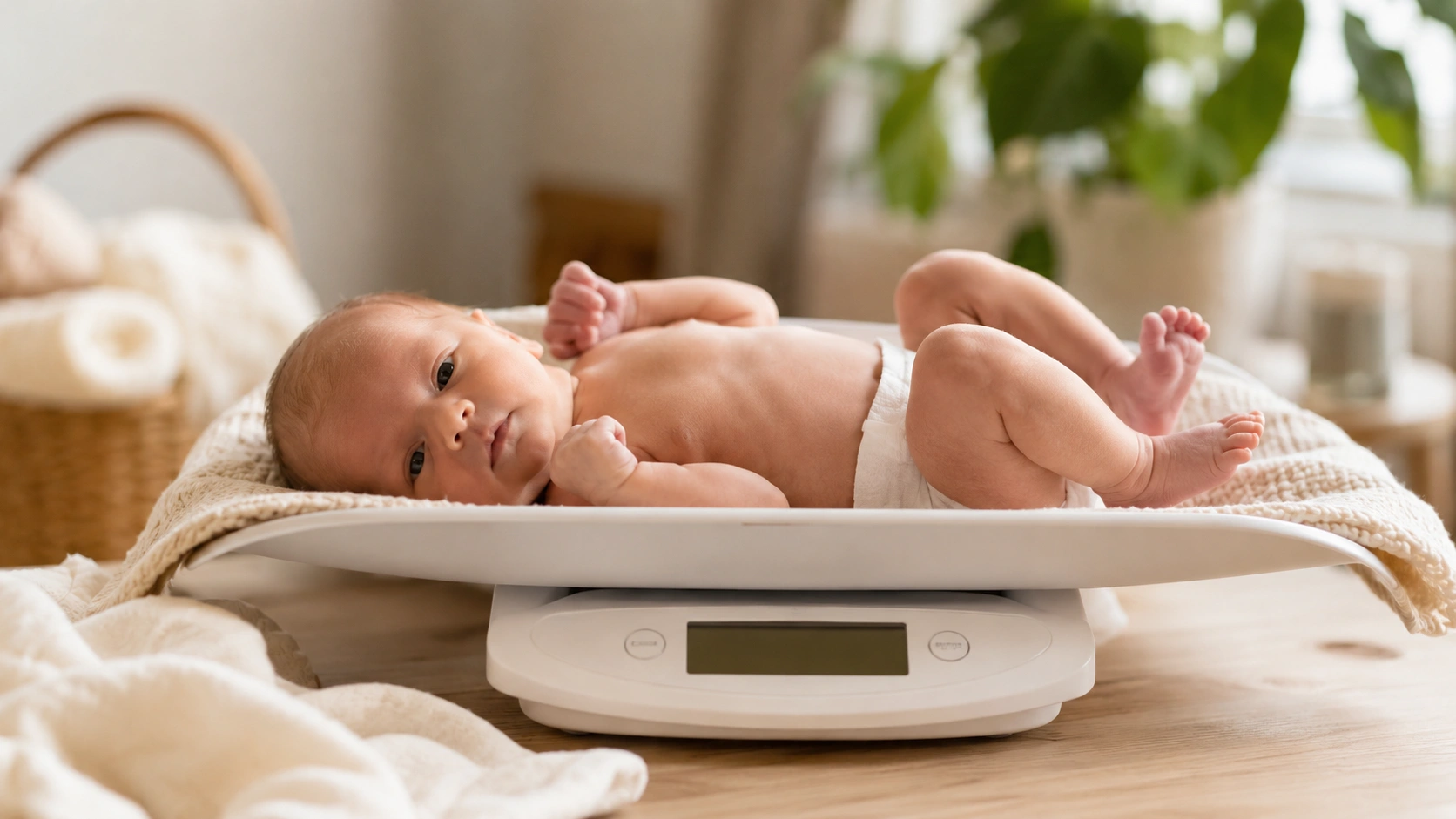
Its not unusual for parents to ask me how much weight their baby should be putting on, whether they should be weighing more often, or what it means if their baby drops a centile on their growth chart.
It’s understandable — there can feel like a lot of focus on weight in the first year of your baby’s life.
But healthy baby growth is rarely perfectly smooth or identical from one baby to another.
Some babies gain weight very quickly. Others grow more gradually. Feeding patterns also change significantly over the first few months, particularly as babies become more alert, active, and efficient at feeding.
Understanding what is actually normal can help you feel more confident interpreting the numbers on the scales and the lines on your baby’s growth chart.
This article focuses on weight gain after your baby has regained their birth weight. If you are looking for information about weight loss in the first days after birth, you may find my article on newborn weight loss more helpful:
Newborn Weight Loss: What’s Normal in the First Days After Birth?
How Quickly Should Babies Gain Weight?
Babies grow very rapidly in the first few months of life.
On average, breastfed babies gain approximately:
- around 200g per week between 2 weeks and 4 months
- around 110g per week between 4 and 6 months
- around 65g per week between 6 and 12 months
However, these are averages — not targets your baby must hit exactly every single week.
Baby weight gain is rarely completely smooth or predictable.
Just like adults, babies’ weights naturally fluctuate slightly from day to day depending on things like:
- how recently they have fed
- whether they have recently done a large poo
- minor illnesses such as a cold
- hydration levels
- scales differing slightly between clinics
- normal variations in feeding patterns
This is one of the reasons healthcare professionals are usually far more interested in your baby’s overall growth pattern over time rather than a single individual weight.
A one-off lower weight does not automatically mean something is wrong, just as one larger gain does not necessarily mean feeding has suddenly dramatically improved.
More frequent weighing can sometimes make normal small fluctuations appear more significant than they really are. This is why, once feeding is established and your baby is well, routine weighing is usually spaced weeks apart rather than performed every few days.
Even something as simple as whether your baby has recently fed or filled their nappy can influence a weight check. In the early months, when babies may gain around 25g per day, small day-to-day weight variations can appear surprisingly significant on the scales.
Do Breastfed and Formula Fed Babies Gain Weight Differently?
Yes — and this is something many parents are not told.
Breastfed and formula fed babies tend to grow similarly in the early months, but after around 3–4 months, formula fed babies often begin gaining weight more rapidly.
This means breastfed babies can sometimes appear leaner compared to formula fed peers, while still growing completely normally.
The World Health Organisation growth charts used in the UK (the one’s in your red book) are based on healthy breastfed babies, because breastfeeding is considered the biological norm for infant feeding.
What Are Centiles?
Centiles are simply lines on a growth chart that help healthcare professionals track growth over time.
They are not a score or grade.
A baby on the:
- 9th centile can be perfectly healthy
- 50th centile can be perfectly healthy
- 91st centile can be perfectly healthy
What usually matters most is whether your baby is generally following their own growth curve over time.
Some babies are naturally smaller.
Some are naturally larger.
Growth is strongly influenced by genetics too.
What If My Baby Drops a Centile?
A drop in centiles does not automatically mean something is wrong.
Sometimes babies simply adjust onto the growth curve that is normal for them, particularly in the first weeks.
However, healthcare professionals may want to assess feeding and growth more closely if:
- your baby crosses centile lines
- weight gain slows significantly
- feeding difficulties are present
- nappies are reduce
- your baby seems unusually sleepy or unsettled
- illness is suspected
Weight is only one part of the assessment.
Your baby’s feeding, development, behaviour, and overall health matter too.
Growth Naturally Slows After the First Few Months
One cause of confusion for parents is when weight gain slows down after the newborn period. This is normal.
Babies grow incredibly quickly in the first 3 months, but after this point growth naturally slows.
Older babies become more alert, more distracted, more active and more efficient feeders. So feeding patterns and weight gain can look very different compared to the early newborn weeks.
This is where your baby’s red book growth chart can be really helpful. Rather than focusing on the exact number on the scales each time, you can look at the overall pattern of growth and whether your baby is broadly following their own curve over time.
Small variations between weight checks are very common, but a baby who is generally tracking along their centile line is usually growing appropriately.
Try Not to Compare Your Baby to Others

Baby groups can unintentionally make parents anxious about weight.
One baby may look very chunky.
Another may look long and lean.
Another may gain rapidly and then plateau.
Just like adults, babies naturally come in different shapes and sizes.
Two healthy babies of the same age can look completely different.
When Should You Seek Feeding Support?
It’s always appropriate to seek support if you feel worried.
Additional assessment may be helpful if:
- your baby is not following their growth curve
- feeds are consistently stressful or painful
- nappies seem reduced
- your baby appears lethargic
- feeds are extremely short or infrequent
- you are regularly needing to “battle” your baby to feed
- your instincts feel something is not right
Often, early feeding support can prevent small concerns from becoming much bigger stresses later on.
Breastfeeding can feel overwhelming — but you don’t have to work it out alone.
If you’d like calm, practical guidance with feeding, positioning or common challenges, I offer video consultations and face-to-face breastfeeding support in and around Salisbury.
You can also explore my Online Breastfeeding Course for clear explanations of how feeding works and how to manage common problems.
Frequent Weighing Can Sometimes Increase Anxiety
After your baby has regained their birth weight, healthy babies usually only need weighing at:
- 8 weeks
- 12 weeks
- 16 weeks
- and again at 1 year
Very frequent weighing is usually unnecessary.
Between 6 and 12 months of age, routine weight checks are generally recommended no more frequently than every 2 months unless there is a specific concern about growth or feeding. More frequent weighing may still be suggested by your healthcare team if closer monitoring is needed.
Healthcare professionals look at your baby’s overall growth pattern rather than normal small day-to-day fluctuations. Weight is important — but it is not the only marker of a thriving baby.
I’ve created a free printable When to Weigh timeline to keep you on track.
Want More Feeding Support?
My online breastfeeding course includes support with:
- understanding normal feeding behaviour
- recognising effective milk transfer
- feeding patterns and growth
- protecting breastfeeding during challenges
- common postnatal challenges
The aim is to help you feel informed, prepared, and confident — rather than constantly second guessing yourself.
You Might Also Find These Helpful